As someone who’s always sought innovation—whether in interactive game design or filmmaking—I’ve used 'Pendulum Drift' as a platform to experiment with both creative narrative and efficient sustainable production methods. It’s a film built not only on storytelling but on a fresh way of thinking about how we create films.
This archive preserves the public record of a private odyssey — from the first declaration of intent in 2005 to the rediscovered prophecy of 2009 and the fulfilment of that vision in 2026. Each cutting is a fragment of sovereignty, proof that a film can be made in five nights and a career sustained for decades through endurance, family, and belief.
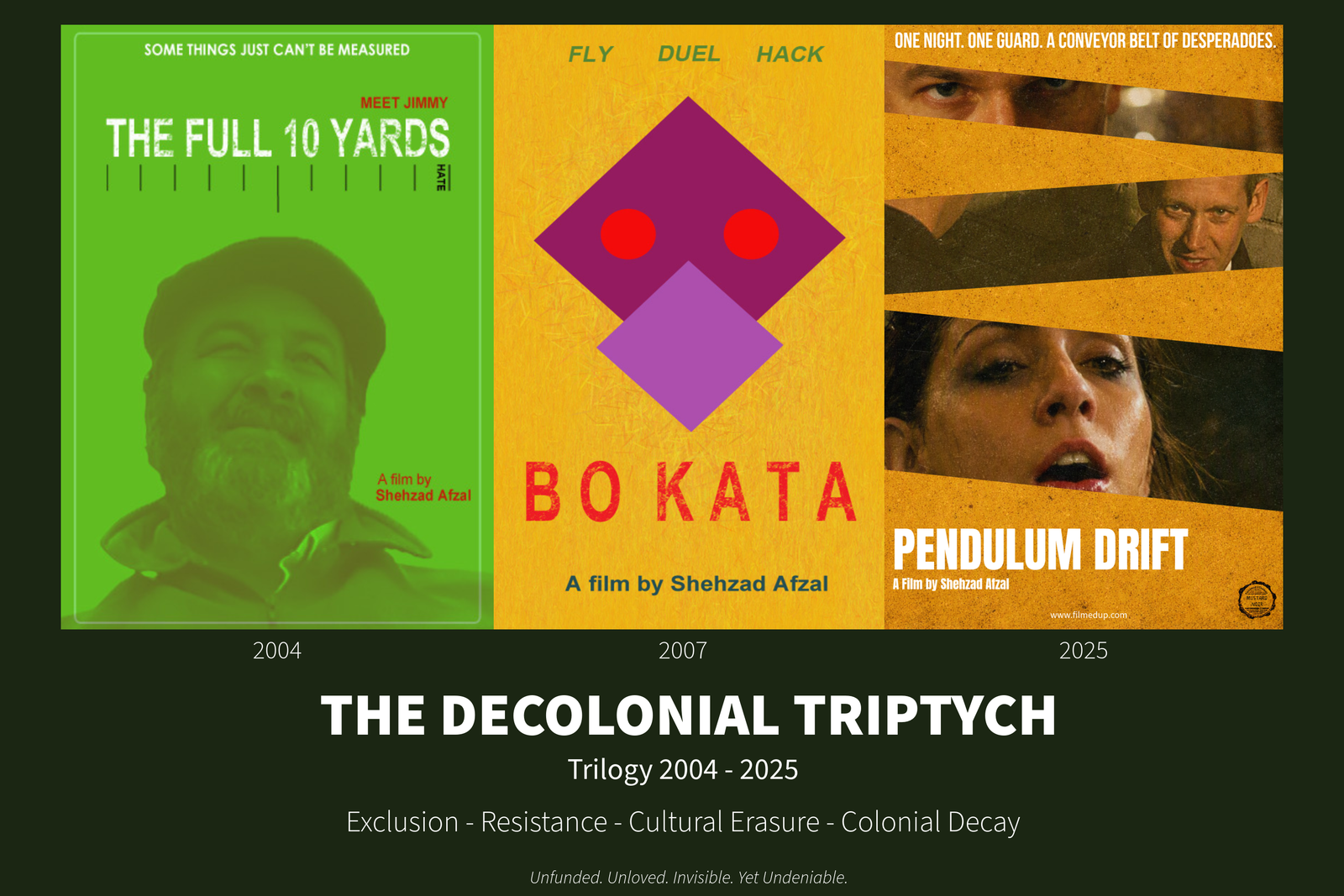
The Full 10 Yards, Bo Kata, and Pendulum Drift form a coherent trilogy exploring themes of exclusion, resistance, cultural erasure, and colonial decay — a body of work shaped by independence, resilience, and cultural responsibility.
Born in Dundee, Scotland, developed an interest in filmmaking at childhood, which later in life helped to drive his creative passion.
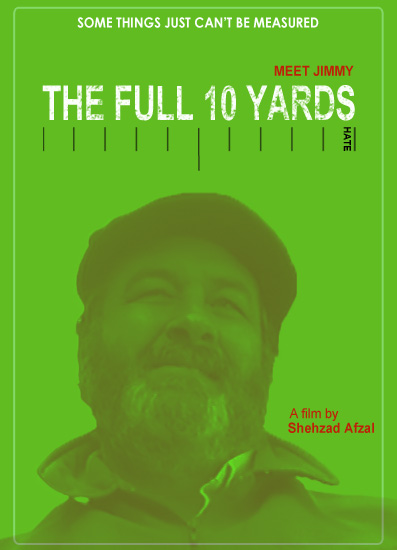
His early work consisted of experimental short documentaries such as Ravi Dreams (2003), observations into the culture and mysticism in Lahore, Pakistan, and Transvestite Days (2004), which offered an insight into the life of a Transvestite. His first drama film was a short graduation piece called, The Full 10 Yards (2004), filmed in Edinburgh, Scotland, a controversial narrative which garnered awards and festival screenings.
The follow up project, a self-funded documentary called Bo Kata (2007), was filmed in Lahore, Pakistan in 2004 but completed and released in 2007. It went on to receive a limited theatrical release in the UK, in-addition to screening at numerous national and international film festivals.
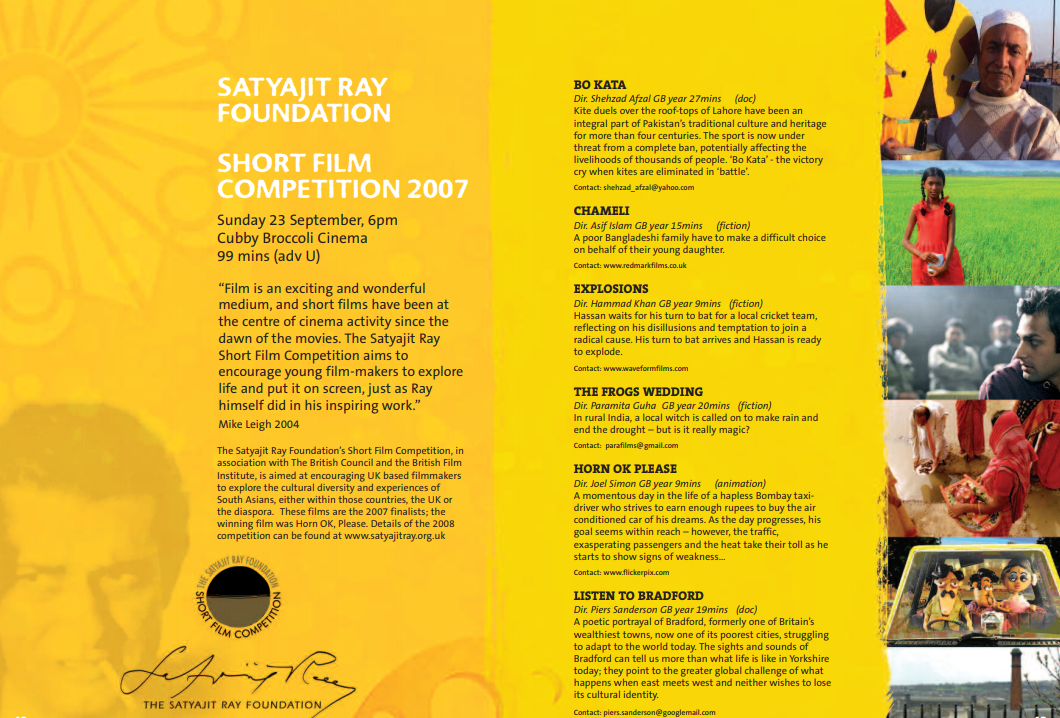
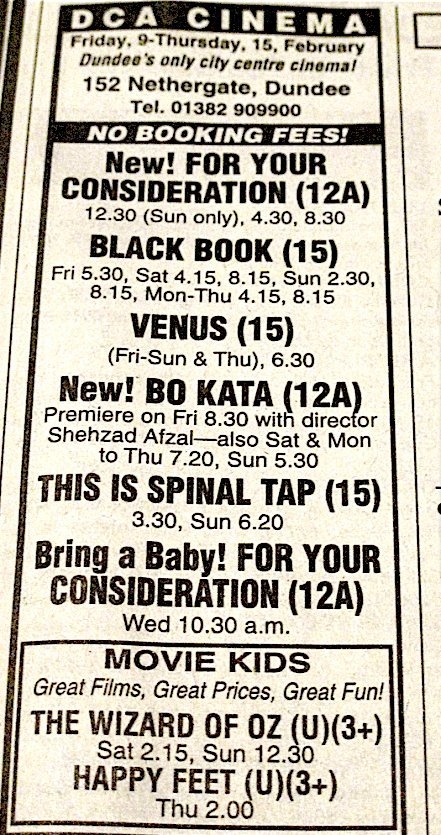
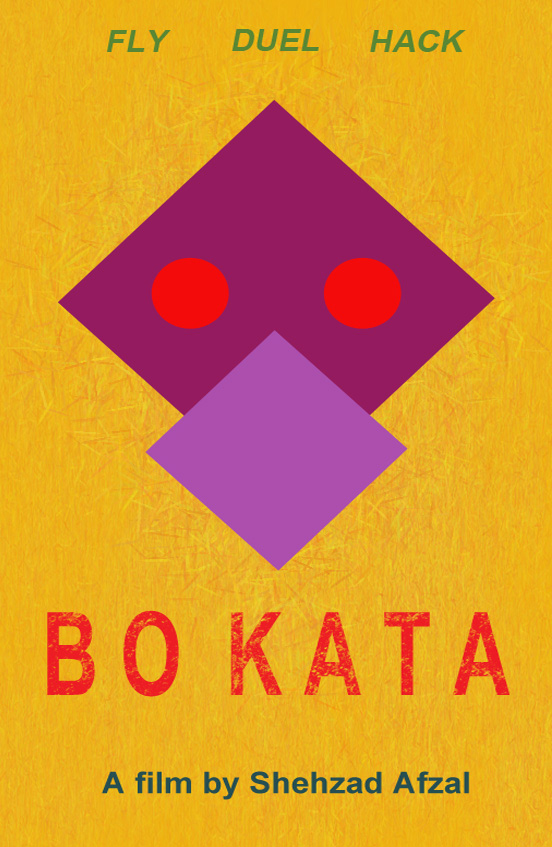
Shehzad was nominated for the Satyajit Ray Film Foundation Award in 2007 for best film (Bo Kata) at a ceremony held in London (with awards presented by BAFTA winning filmmaker Asif Kapadia), in association with the British Council and British Film Institute.
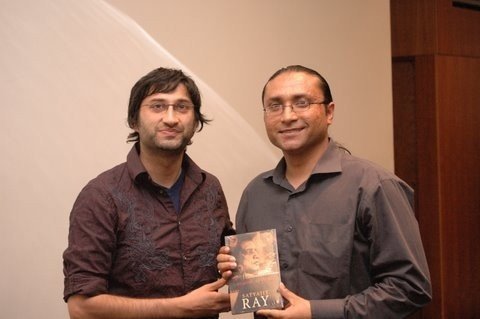
Bafta/Oscar Winning Filmmaker Asif Kapadia & Satyajit Ray Nominated Filmmaker Shehzad Afzal
His other projects, a number of game designs and concepts, won him a place as a finalist for the Global Digital Cities Game Design competition on two occasions (2005 and 2007).
Shehzad is a former graduate of Robert Gordons University, Aberdeen, and Abertay University, Dundee, studying computer science and creative writing. Gained a Postgraduate Diploma in Management from Dundee College presented to him by Dundee United football legend, Paul Sturrock.
In 2007, he commenced a Master of Arts in Screen Project Development from Screen Academy Scotland. He gained his Masters with distinction, winning the first prize award for his academic achievements and receiving the prestigious Edinburgh Napier University Class Medal.
Press Article by The Courier:
The Monday Interview: Showing racism red card, September 26, 2005, by Jack McKeown, The Courier
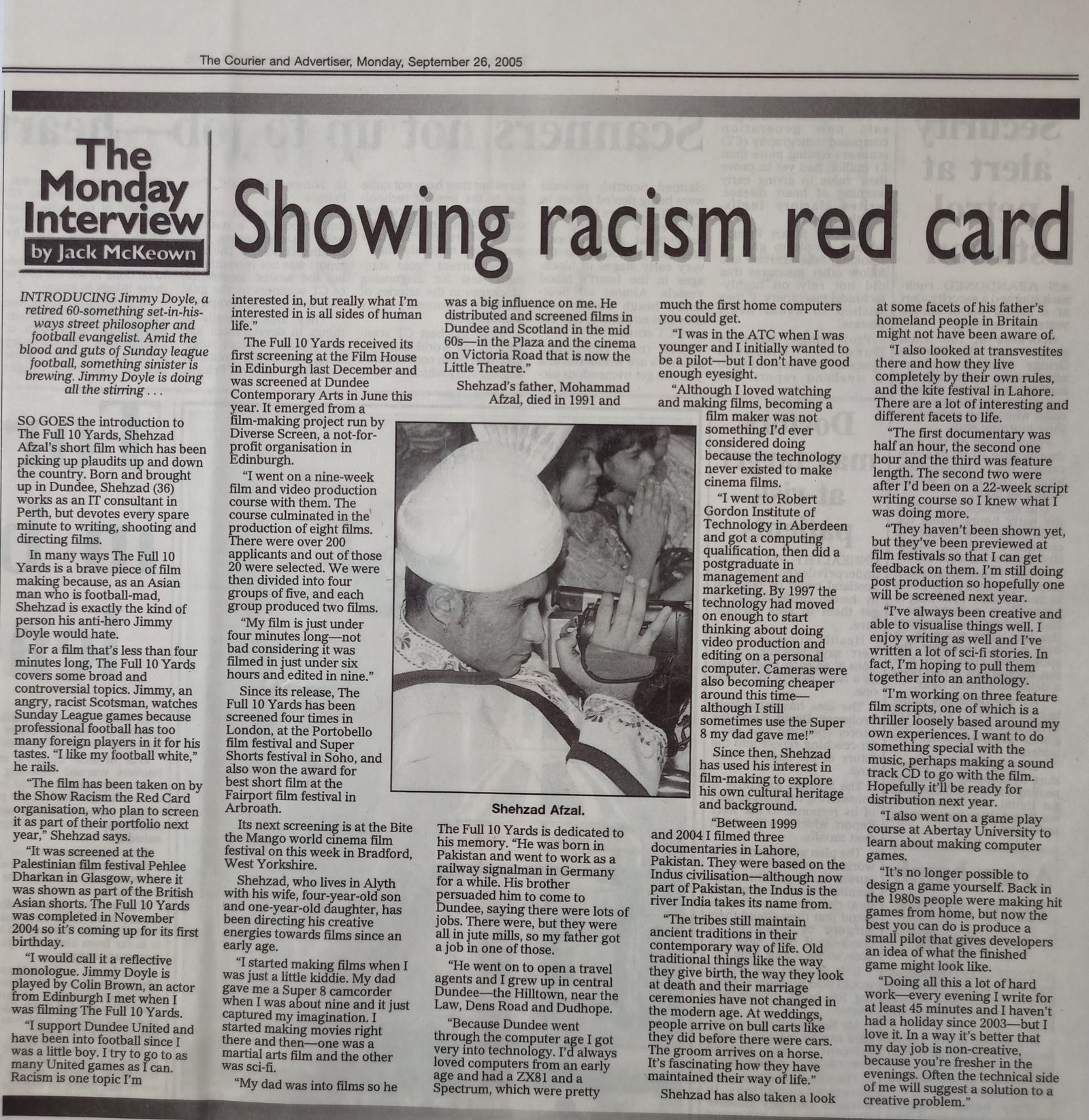
Full Transcipt From Article (The Courier, September 26, 2005, by Jack McKeown)
INTRODUCING Jimmy Doyle, a retired 60-something set-in-his-ways street philosopher and football evangelist. Amid the blood and guts of Sunday league football, something sinister is brewing. Jimmy Doyle is doing all the stirring...
SO GOES the introduction to The Full 10 Yards, Shehzad Afzal's short film which has been picking up plaudits up and down the country. Born and brought up in Dundee, Shehzad (36) works as an IT consultant in Perth, but devotes every spare minute to writing, shooting and directing films.
In many ways The Full 10 Yards is a brave piece of film making because, as an Asian man who is football-mad, Shehzad is exactly the kind of person his anti-hero Jimmy Doyle would hate.
For a film that's less than four minutes long, The Full 10 Yards covers some broad and controversial topics. Jimmy, an angry, racist Scotsman, watches Sunday League games because professional football has too many foreign players in it for his tastes. "I like my football white," he rails.
"The film has been taken on by the Show Racism the Red Card organisation, who plan to screen it as part of their portfolio next year," Shehzad says.
"It was screened at the Palestinian film festival Pehlee Dharkan in Glasgow, where it was shown as part of the British Asian shorts. The Full 10 Yards was completed in November 2004 so it's coming up for its first birthday."
"I would call it a reflective monologue. Jimmy Doyle is played by Colin Brown, an actor from Edinburgh I met when I was filming The Full 10 Yards."
"I support Dundee United and have been into football since I was a little boy. I try to go to as many United games as I can. Racism is one topic I'm interested in, but really what I'm interested in is all sides of human life."
The Full 10 Yards received its first screening at the Film House in Edinburgh last December and was screened at Dundee Contemporary Arts in June this year. It emerged from a film-making project run by Diverse Screen, a not-for-profit organisation in Edinburgh.
"I went on a nine-week film and video production course with them. The course culminated in the production of eight films. There were over 200 applicants and out of those 20 were selected. We were then divided into four groups of five, and each group produced two films."
"My film is just under four minutes long—not bad considering it was filmed in just under six hours and edited in nine."
Since its release, The Full 10 Yards has been screened four times in London, at the Portobello film festival and Super Shorts festival in Soho, and also won the award for best short film at the Fairport film festival in Arbroath.
Its next screening is at the Bite the Mango world cinema film festival on this week in Bradford, West Yorkshire.
Shehzad, who lives in Alyth with his wife, four-year-old son and one-year-old daughter, has been directing his creative energies towards films since an early age.
"I started making films when I was just a little kiddie. My dad gave me a Super 8 camcorder when I was about nine and it just captured my imagination. I started making movies right there and then—one was a martial arts film and the other was sci-fi."
"My dad was into films so he was a big influence on me. He distributed and screened films in Dundee and Scotland in the mid 60s—in the Plaza and the cinema on Victoria Road that is now the Little Theatre."
The Full 10 Yards is dedicated to his memory. "He was born in Pakistan and went to work as a railway signalman in Germany for a while. His brother persuaded him to come to Dundee, saying there were lots of jobs. There were, but they were all in jute mills, so my father got a job in one of those."
"He went on to open a travel agency and I grew up in central Dundee—the Hilltown, near the Law, Dens Road and Dudhope."
"Because Dundee went through the computer age I got very into technology. I'd always loved computers from an early age and had a ZX81 and a Spectrum, which were pretty much the first home computers you could get."
"I was in the ATC when I was younger and I initially wanted to be a pilot—but I don't have good enough eyesight."
"Although I loved watching and making films, becoming a film maker was not something I'd ever considered doing because the technology never existed to make cinema films."
"I went to Robert Gordon Institute of Technology in Aberdeen and got a computing qualification, then did a postgraduate in management and marketing. By 1997 the technology had moved on enough to start thinking about doing video production and editing on a personal computer. Cameras were also becoming cheaper around this time—although I still sometimes use the Super 8 my dad gave me!"
Since then, Shehzad has used his interest in film-making to explore his own cultural heritage and background.
"Between 1999 and 2004 I filmed three documentaries in Lahore, Pakistan. They were based on the Indus civilisation—although now part of Pakistan, the Indus is the river India takes its name from."
"The tribes still maintain ancient traditions in their contemporary way of life. Old traditional things like the way they give birth, the way they look at death and their marriage ceremonies have not changed in the modern age. At weddings, people arrive on bull carts like they did before there were cars. The groom arrives on a horse. It's fascinating how they have maintained their way of life."
Shehzad has also taken a look at some facets of his father's homeland people in Britain might not have been aware of.
"I also looked at transvestites there and how they live completely by their own rules, and the kite festival in Lahore. There are a lot of interesting and different facets to life."
"The first documentary was half an hour, the second one hour and the third was feature length. The second two were after I'd been on a 22-week script writing course so I knew what I was doing more."
"They haven't been shown yet, but they've been previewed at film festivals so that I can get feedback on them. I'm still doing post production so hopefully one will be screened next year."
"I've always been creative and able to visualise things well. I enjoy writing as well and I've written a lot of sci-fi stories. In fact, I'm hoping to pull them together into an anthology."
"I'm working on three feature film scripts, one of which is a thriller loosely based around my own experiences. I want to do something special with the music, perhaps making a sound track CD to go with the film. Hopefully it'll be ready for distribution next year."
"I also went on a game play course at Abertay University to learn about making computer games."
"It's no longer possible to design a game yourself. Back in the 1980s people were making hit games from home, but now the best you can do is produce a small pilot that gives developers an idea of what the finished game might look like."
"Doing all this a lot of hard work—every evening I write for at least 45 minutes and I haven't had a holiday since 2003—but I love it. In a way it's better that my day job is non-creative, because you're fresher in the evenings. Often the technical side of me will suggest a solution to a creative problem."
[Note: Original print article erroneously printed 'Palestinian' instead of 'Pakistani Film Festival'])
- Jack McKeown, The Courier
Roughcuts Magazine - Going The Full 10 Yards, Filmmaker Focus:
Roughcuts Magazine Dec-2007, Jan-2008
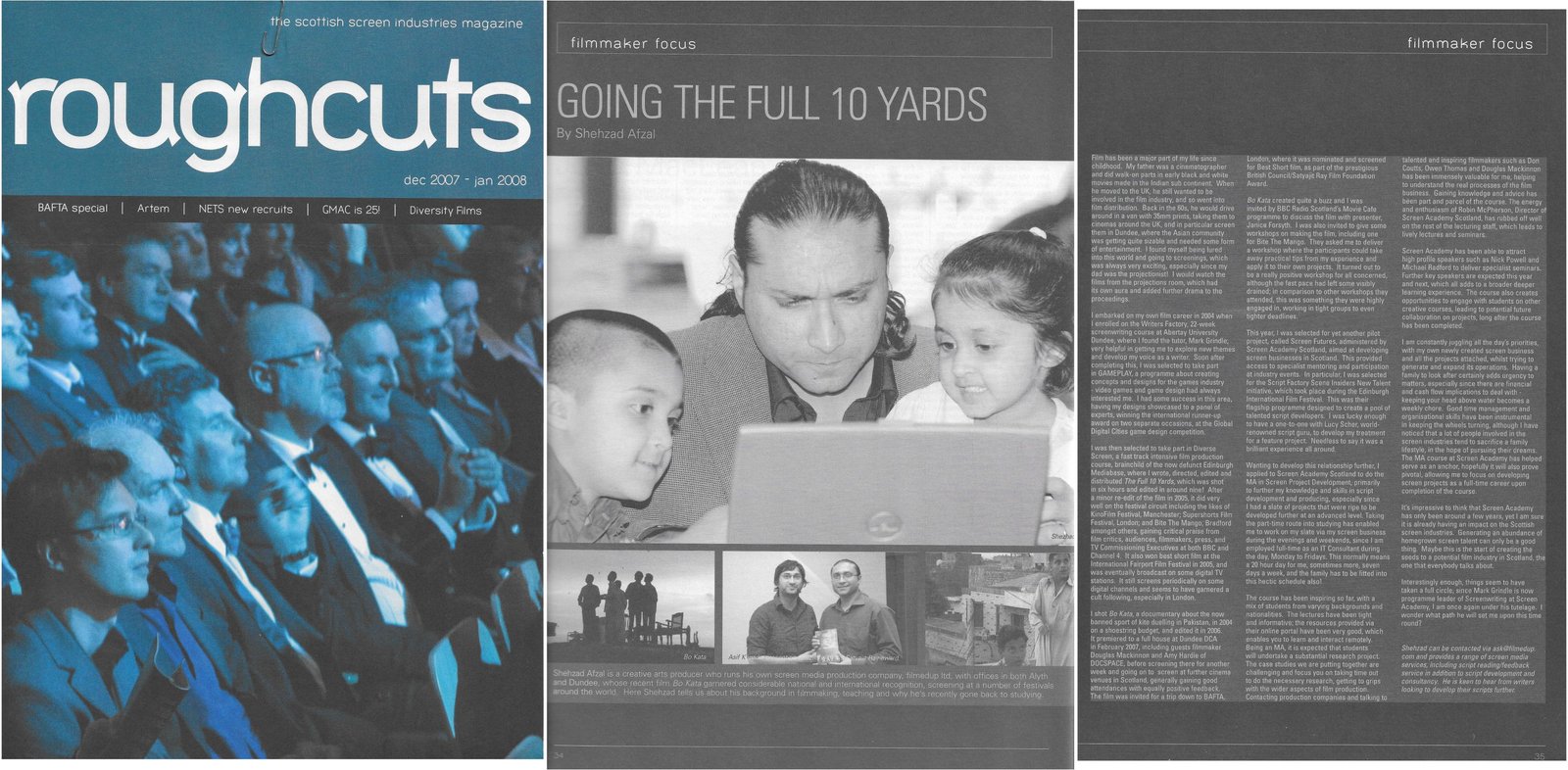
Full Transcipt From Article (Roughtcuts Magazine Dec-2007, Jan-2008)
Film has been a major part of my life since childhood. My father was a cinematographer and did walk-on roles in early black and white movies made in the Indian sub continent. When he moved to the UK, he still wanted to be involved in the film industry and so went into film distribution. Back in the 80s, he would drive around in a van with 35mm prints, taking them to cinemas around the UK, and in particular screen them in Dundee, where the Asian community was getting quite sizable and needed some form of entertainment. I found myself being lured into this world and going to screenings, which was always very exciting, especially since my dad was the projectionist! I would watch the films from the projection room, which had its own aura and added further drama to the proceedings.
I embarked on my own film career in 2004 when I enrolled on the Writers Factory, 22-week screenwriting course at Abertay University Dundee, where I found the tutor, Mark Grindle, very helpful in getting me to explore new themes and develop my voice as a writer. Soon after completing this, I was selected to take part in GAMEPLAY, a programme about creating concepts and designs for the games industry video games and game design had always interested me. I had some success in this area, having my designs showcased to a panel of experts, winning the international runner-up award on two separate occasions, at the Global Digital Cities game design competition.
I was then selected to take part in Diverse Screen, a fast track intensive film production course, brainchild of the now defunct Edinburgh Mediabase, where I wrote, directed, edited and distributed The Full 10 Yards, which was shot in six hours and edited in around nine! After a minor re-edit of the film in 2005, it did very well on the festival circuit including the likes of Kino Film International Festival, Manchester; Supershorts Film Festival, London; and Bite The Mango, Bradford amongst others, gaining critical praise from film critics, audiences, filmmakers, press, and TV Commissioning Executives at both BBC and Channel 4. It also won best short film at the International Fairport Film Festival in 2005, and was eventually broadcast on some digital TV stations. It still screens periodically on some digital channels and seems to have garnered a cult following, especially in London.
I shot Bo Kata, a documentary about the now-banned sport of kite duelling in Pakistan, in 2004 on a shoestring budget, and edited it in 2006. It premiered to a full house at Dundee DCA in February 2007, including guests filmmaker Douglas Mackinnon and Amy Hardie of DOCSPACE, before screening there for another week and going on to screen at further cinema venues in Scotland, generally gaining good attendances with equally positive feedback. The film was invited for a trip down to BAFTA, London, where it was nominated and screened for Best Short film, as part of the prestigious British Council/Satyajit Ray Film Foundation Award.
Bo Kata created quite a buzz and I was invited by BBC Radio Scotland's Movie Cafe programme to discuss the film with presenter, Janice Forsyth. I was also invited to give some workshops on making the film, including one for Bite The Mango. They asked me to deliver a workshop where the participants could take away practical tips from my experience and apply it to their own projects. It turned out to be a really positive workshop for all concerned, although the fast pace had left some visibly drained in comparison to other workshops they attended, this was something they were highly engaged in, working in tight groups to even tighter deadlines.
This year, I was selected for yet another pilot project, called Screen Futures, administered by Screen Academy Scotland, aimed at developing screen businesses in Scotland. This provided access to specialist mentoring and participation at industry events. In particular, I was selected for the Script Factory Scene Insiders New Talent initiative, which took place during the Edinburgh International Film Festival. This was their flagship programme designed to create a pool of talented script developers. I was lucky enough to have a one-to-one with Lucy Scher, world-renowned script guru, to develop my treatment for a feature project. Needless to say it was a brilliant experience all round.
Wanting to develop this relationship further, I applied to Screen Academy Scotland to do the MA in Screen Project Development, primarily to further my knowledge and skills in script development and producing, especially since I had a slate of projects that were ripe to be developed further at an advanced level. Taking the part-time route into studying has enabled me to work on my slate via my screen business during the evenings and weekends, since I am employed full-time as an IT Consultant during the day, Monday to Fridays. This normally means a 20 hour day for me, sometimes more, seven days a week, and the family has to be fitted into this hectic schedule also!
The course has been inspiring so far, with a mix of students from varying backgrounds and nationalities. The lectures have been tight and informative; the resources provided via their online portal have been very good, which enables you to learn and interact remotely. Being an MA, it is expected that students will undertake a substantial research project. The case studies we are putting together are challenging and focus you on taking time out to do the necessary research, getting to grips with the wider aspects of film production. Contacting production companies and talking to talented and inspiring filmmakers such as Dan Ccurts, Owen Thomas and Douglas Mackinnon has been immensely valuable for me, helping to understand the real processes of the film business. Gaining knowledge and advice has been part and parcel of the course. The energy and enthusiasm of Robin MacPherson, Director of Screen Academy Scotland, has rubbed off well on the rest of the lecturing staff, which leads to lively lectures and seminars.
Screen Academy has been able to attract high profile speakers such as Nick Powell and Michael Radford to deliver specialist seminars. Further key speakers are expected this year and next, which all adds to a broader deeper learning experience. The course also creates opportunities to engage with students on other creative courses, leading to potential future collaboration on projects, long after the course has been completed.
I am constantly juggling all the day's priorities, with my own newly created screen business and all the projects attached, whilst trying to generate and expand its operations. Having a family to look after certainly adds urgency to matters, especially since there are financial and cash flow implications to deal with; keeping your head above water becomes a weekly chore. Good time management and organisational skills have been instrumental in keeping the wheels turning, although I have noticed that a lot of people involved in the screen industries tend to sacrifice a family lifestyle, in the hope of pursuing their dreams. The MA course at Screen Academy has helped serve as an anchor, hopefully it will also prove pivotal, allowing me to focus on developing screen projects as a full-time career upon completion of the course.
It's impressive to think that Screen Academy has only been around a few years, yet I am sure it is already having an impact on the Scottish screen industries. Generating an abundance of homegrown screen talent can only be a good thing. Maybe this is the start of creating the seeds to a potential film industry in Scotland, the one that everybody talks about.
Interestingly enough, things seem to have taken a full circle, since Mark Grindle is now programme leader of Screenwriting at Screen Academy, I am once again under his tutelage; I wonder what path he will set me upon this time round?
Press Article by The Courier:
String Time, February 09, 2007, by Jack McKeown, The Courier
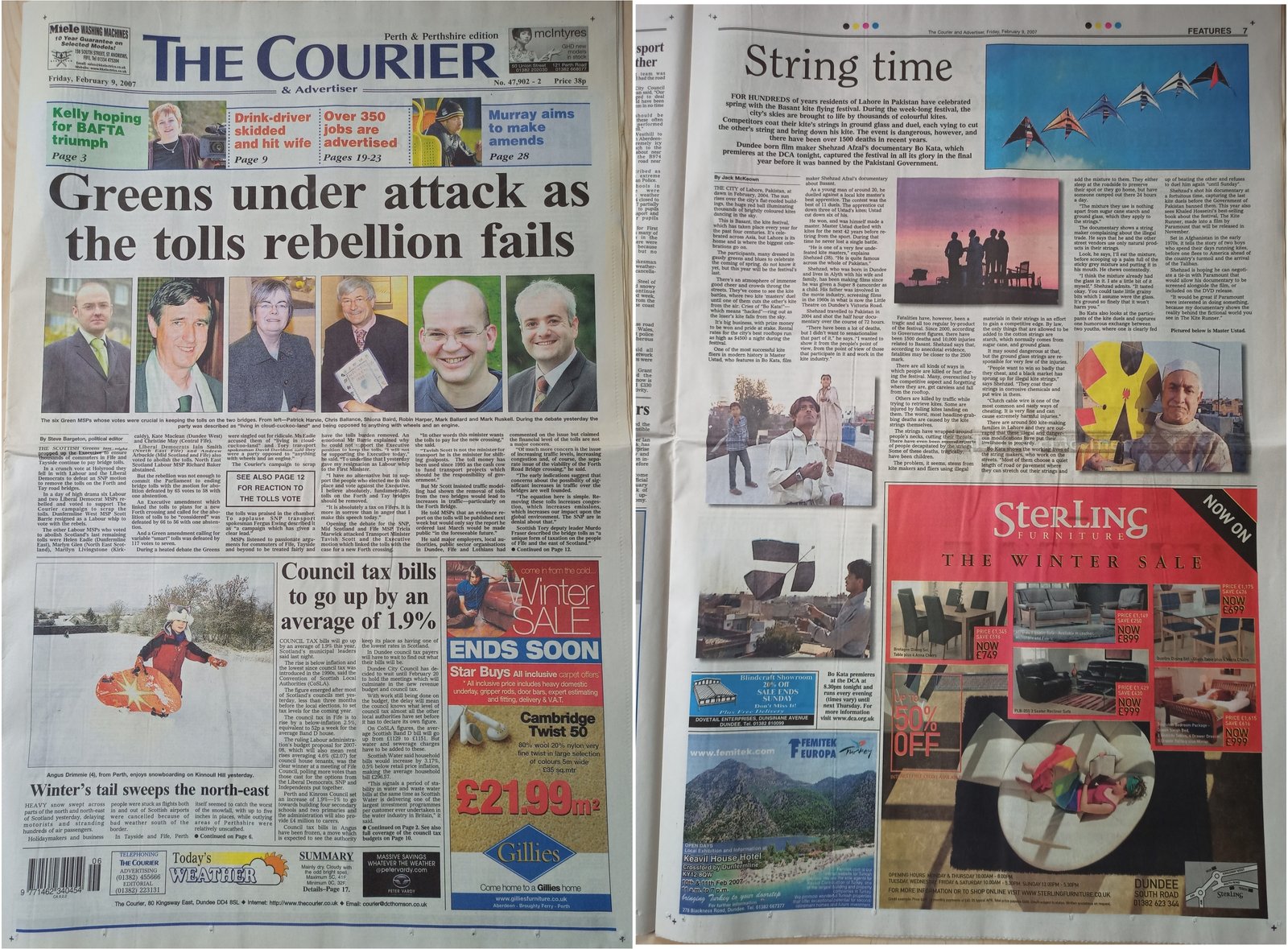
Full Transcipt From Article (The Courier, February 09, 2007, by Jack McKeown)
String time, By Jack McKeown
FOR HUNDREDS of years residents of Lahore in Pakistan have celebrated spring with the Basant kite flying festival. During the week-long festival, the city's skies are brought to life by thousands of colourful kites. Competitors coat their kite's strings in ground glass and duel, each vying to cut the other's string and bring down his kite. The event is dangerous, however, and there have been over 1500 deaths in recent years.
Dundee born film maker Shehzad Afzal's documentary Bo Kata, which premieres at the DCA tonight, captured the festival in all its glory in the final year before it was banned by the Pakistani Government.
THE CITY of LAHORE, Pakistan, at dawn in February, 2004. The sun rises over the city's flat-roofed buildings, the huge red ball illuminating thousands of brightly coloured kites dancing in the sky.
This is Basant, the kite festival, which has taken place every year for the past four centuries. It's celebrated across Asia, but Lahore is its home and is where the biggest celebrations go on.
The participants, many dressed in gaudy greens and blues to celebrate the coming of spring, do not know it yet, but this year will be the festival's last.
There's an atmosphere of immense good cheer and crowds throng the streets. They've come to see the kite battles, where two kite 'masters' duel until one of them cuts the other's kite from the air. Cries of "Bo Kata!"—which means "hacked"—ring out as the loser's kite falls from the sky.
It's big business, with prize money to be won and pride at stake. Rental rates for city's best rooftops run as high as $4500 a night during the festival.
One of the most successful kite fliers in modern history is Master Ustad, who features in the Bo Kata, filmmaker Shehzad Afzal's documentary about Basant.
As a young man of around 20, he duelled against a local kite master's best apprentice. The contest was the best of 11 duels. The apprentice cut down three of Ustad's kites; Usatd cut down six of his.
He won, and was himself made a master. Master Ustad duelled with kites for the next 42 years before retiring from the sport. During that time he never lost a single battle.
"He is one of the very few undefeated kite master," explains Shehzad(38). "He is quite famous across the whole of Pakistan."
Shehzad, who was born in Dundee and lives in Alyth with his wife and family, has been making films since he was given a Super 8 camcorder as a child. His father was involved in the movie industry, screening films in the 1960s in what is not the Little Theatre on Dundee's Victoria Road.
Shehzad travelled to Pakistan in 2004 and shot the the half hour documentary over the course of 72 hours.
"There have been a lot of deaths, but I didn't want to sensationalise that part of it," he says. "I wanted to show it from the people's point of view, from the point of view of those that participate in it and work in the kite industry."
Fatalities have, however, been a tragic and all too regular by-product of the festival. Since 2000, according to Government figures, there have been 1500 deaths and 10,000 injuries related to Basant. Shehzad says that, according to anecdotal evidence, fatalities may be closed to the 2500 mark.
There are all kinds of ways in which people are killed or hurt during the festival. Many, overexcited by the competitive aspect and forgetting where they are, get careless and fall from the rooftop.
Others are killed by traffic while trying to retrieve kites. Some are injured by falling kites landing on them. The worst, most headline-grabbing deaths are caused by the kite strings themselves.
The strings have wrapped around people's necks, cutting their throats. There have even been several reports of people decapitated by the strings. Some of these deaths, tragically, have been children.
The problem, it seems, stems from kite makers and fliers using illegal materials in their strings in an effort to gain a competitive edge. By law, the only things that are allowed to be added to the cotton strings are starch, which normally comes from the sugar cane, and ground glass.
It may sound dangerous at that, but the ground glass strings are responsible for the very few of the injuries.
"People want to win so badly that they cheat, and a black market has sprung up for illegal kite strings," says Shehzad. "They coat their strings in corrosive chemicals and put wire in them. Clutch cable wire is one of the most common and nasty ways of cheating. It is very fine and can cause extremely harmful injuries."
There are aorund 500 kite-making families in Lahore and they are outraged that these illegal and dangerous modifications have put their livelihoods in jeopardy.
Bo Kata shows the working lives of the string makers who work on the streets. "Most of them choose a quiet lenght of road or pavement where they can stretch out their strings and add mixture to them. They either sleep at the roadside to preserve their spot or they go home, but have someone camped out there 24 hours a day.
"The mixture they use is nothing apart from sugar cane starch and ground glass, which they apply to the strings."
The documentary shows a string maker complaining about the illegal trade. He says that he and the other street vendors use only natural products in their strings.
Look, he says, I'll eat the mixture, before scooping up a palm full of the sticky grey mixture and putting it in his mouth. He chews contendedly.
"I think the mixture already had glass in it. I ate a little bit of it myself," Shehzad admits. "It tasted okay. You could taste little grainy bits which i assume were the glass. It's ground so finely that it won't harm you."
Bo Kata also looks at the participants of the kite duels and captures one humourous exchange between two youths, where one is clearly fed up of beating the other and refuses to duel him again "until Sunday".
Shehzad's shot his documentary at a fortuitous time, capturing the last kite duels before the Government of Pakistan banned them. This year also sees Khaled Hosseini's best selling book about the festival, The Kite Runner, made into a film bby Paramount that will be released in November.
Set in Afghanistan in the early 1970s, it tells the story of two boys who spend their days running kites, before one flees to America ahead of the country's turmoil and the arrival of the Taliban.
Shehzad is hoping he can negotiate a tie-in with Paramount that would allow his documentary to be screened alongside the film, or included on the DVD release.
"It would be great of Paramount were interested in doing something, because my documentary shows the reality behind the fictional world you see in the Kite Runner."
Captions & Event Info
Photo Caption: Bo Kata premieres at the DCA at 8.30pm tonight and runs every evening (times vary) until next Thursday. For more information visit www.dca.org.uk
- Jack McKeown, The Courier
During 2008, Shehzad had the oppourtunity to apply his screenwriting skills and knowledge, working as a script consultant for South West Screen Film Agency. Managing all his other full-time commitments in IT, in-addition to his on-going studies in film.
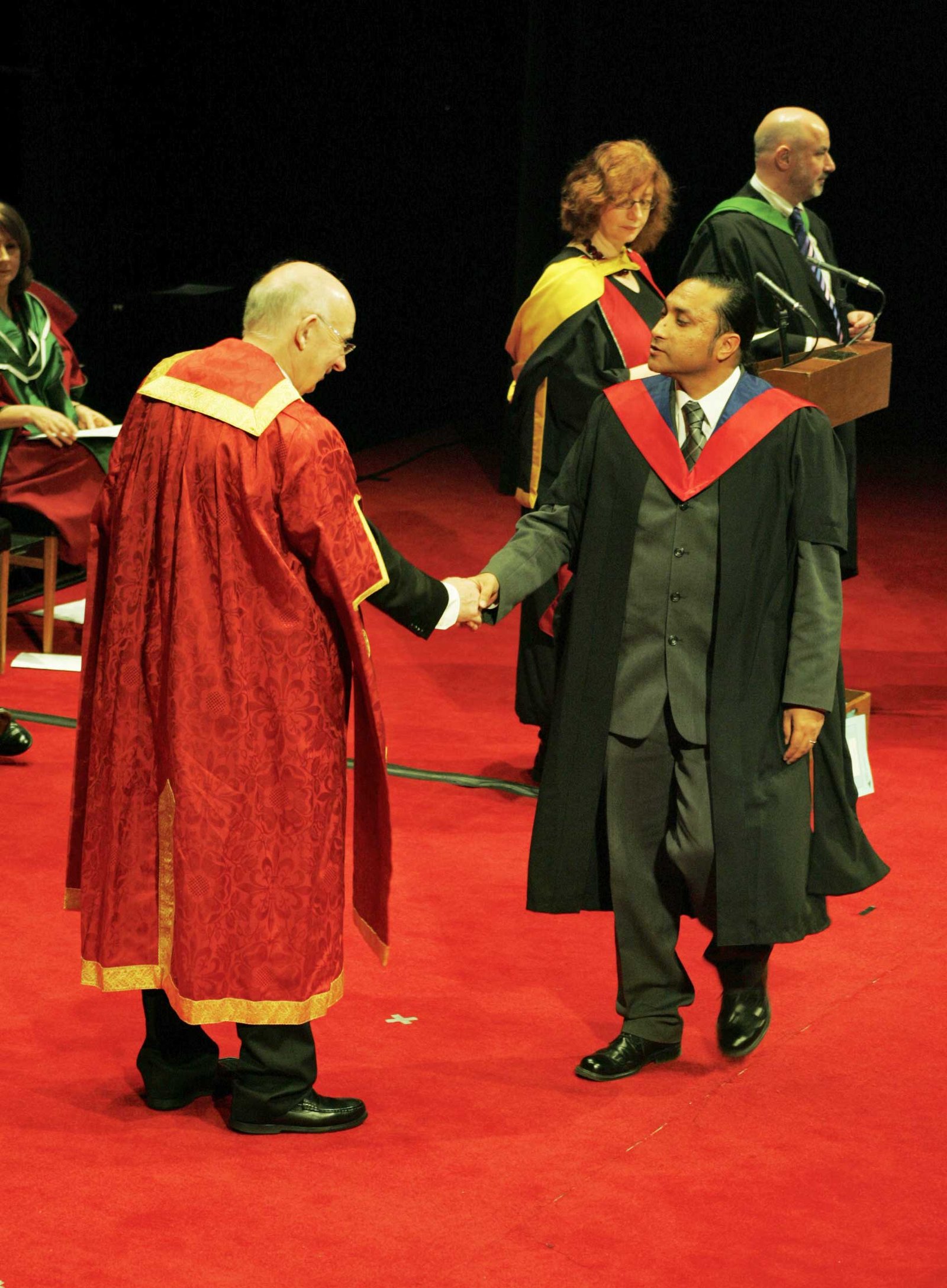
During his time at the Screen Academy Scotland, Shehzad produced two short films, which went on to win many awards. One of which was a collaboration first between Screen Academy Scotland and Screen Academy Wales.
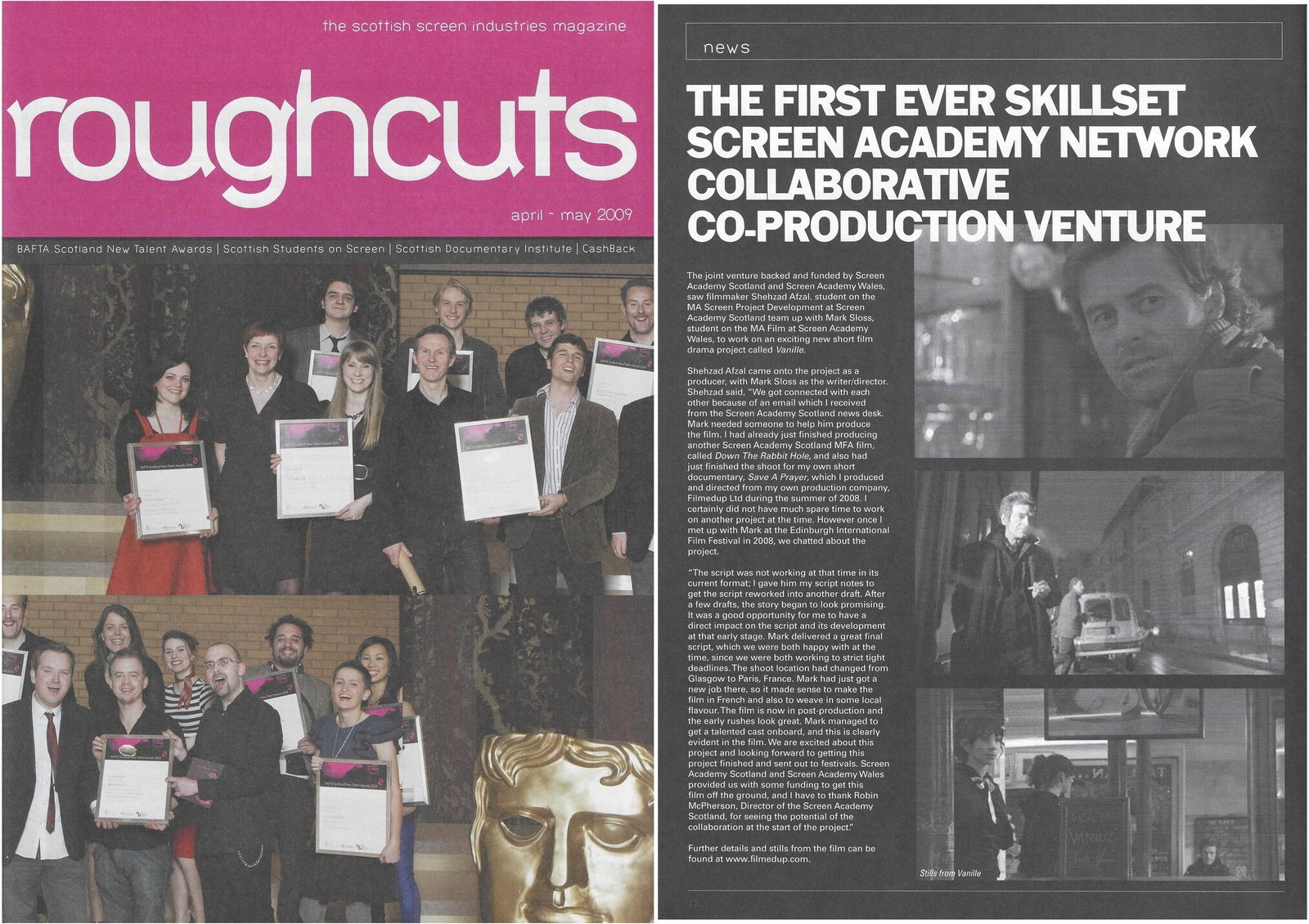
Roughcuts Industry Magazine (Apr-May, 2009):
THE FIRST EVER SKILLSET SCREEN ACADEMY NETWORK COLLABORATIVE CO-PRODUCTION VENTURE, Apr-May, 2009
This article notes Afzal’s first UK wide collaboration on film between 2 national Screen Academies (Scotland/Wales).
Full Transcipt From Article (Roughtcuts Magazine Apr-May, 2009)
The joint venture backed and funded by Screen Academy Scotland and Screen Academy Wales saw filmmaker Shehzad Afzal, student on the MA Screen Project Development at Screen Academy Scotland team up with Mark Sloss, student on the MA Film at Screen Academy Wales, to work on an exciting new short film drama project called Vanille.
Shehzad Afzal came onto the project as a producer, with Mark Sloss as the writer/director. Shehzad said, "We got connected with each other because of an email which I received from the Screen Academy Scotland director Robin MacPherson. Mark needed a producer for his short film, and as I had already produced another Screen Academy Scotland MA film, called Down The Rabbit Hole, and also had just finished The Shoot for my own short documentary, Save A Prayer, which I produced and directed through my own production company, FilmedUp Ltd during the summer of 2008. I certainly did not have much space in my workload and budget at the time. However, when I met up with Mark at the Edinburgh International Film Festival in 2008, we chatted about the project.
"The script was not working at that time in its current format. I gave him my script notes to get the script reworked into another draft. After a few drafts, the story began to look promising and it was a good opportunity for me to have a direct impact on the script and its development at that early stage. Mark delivered a great final script, which we were both happy with at the time, since we were both working to strict light deadlines. The shoot location had changed from Glasgow to Paris, France. Mark had just got a new job there, so it made sense to make the film in French and also to weave in a more local flavour. The film is now in post-production and the early rushes look great. Mark managed to get a talented cast on board, and this is clearly evident in the film. We are excited about this project and looking forward to getting this project finished and sent out to festivals. Screen Academy Scotland and Screen Academy Wales provided us with some funding to get this off the ground, and I have to thank Robin MacPherson, Director of the Screen Academy Scotland, for seeing the potential for the collaboration at the start of the project."
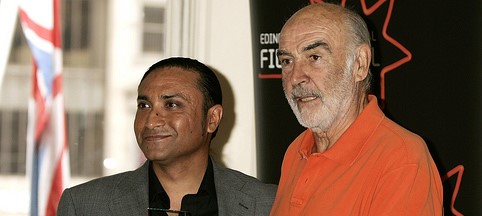
In 2009, Shehzad was presented the Edinburgh International Film Festival Trailblazer award, celebrating emerging British talent in cinema, an award which was presented to him by Sir Sean Connery.
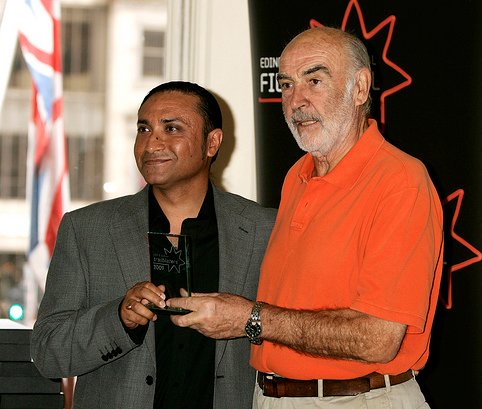
Bafta/Oscar Winning Filmmaker Sir Sean Connery & EIFF 2009 Trailblazer Award Winning Filmmaker Shehzad Afzal
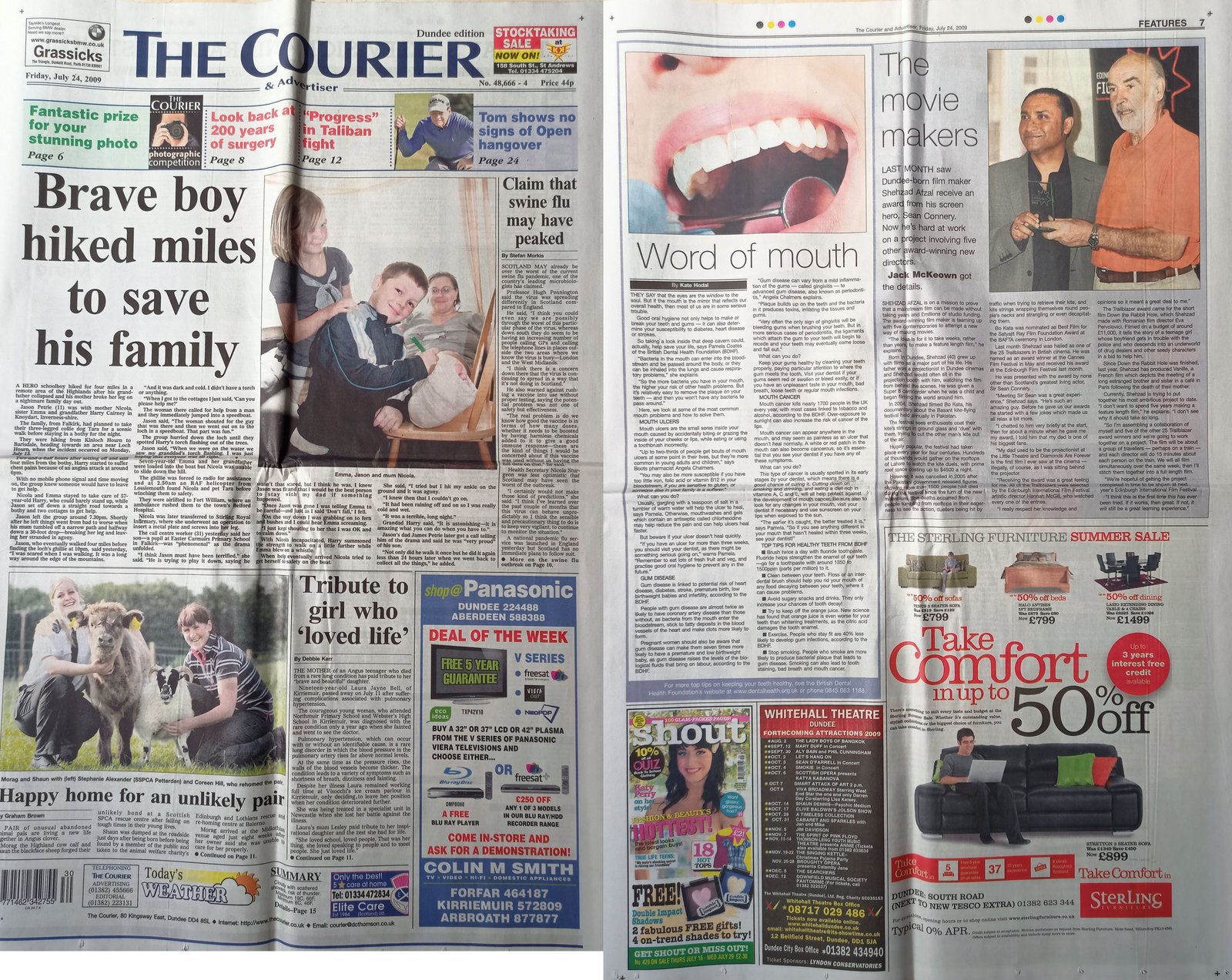
Press Article by The Courier:
The Movie Makers, July 24, 2009, by Jack McKeown, The Courier
Full Transcipt From Article (The Courier, July 24, 2009, The Movie Makers, by Jack McKeown)
The Movie Makers, By Jack McKeown
LAST MONTH saw Dundee-born film maker Shehzad Afzal receive an award from his screen hero, Sean Connery. Now he’s hard at work on a project involving five other award-winning new directors.
Jack McKeown got the details.
SHEHZAD AFZAL is on a mission to prove that a mainstream film can be made without taking years and £millions of studio funding. The award-winning film maker is teaming up with five contemporaries to attempt a new way of making movies.
“The idea is for it to take weeks, rather than years, to make a feature length film,” he explains.
Born in Dundee, Shehzad (40) grew up with films as a major part of his life. His father was a projectionist in Dundee cinemas and Shehzad would often sit in the projection booth with him, watching the film from behind the scenes. He was given a Super 8 camcorder when he was a child and began filming the world around him.
In 2004, Shehzad filmed Bo Kata, his documentary about the Basant kite-flying festival held annually in Pakistan.
The festival sees enthusiasts coat their kite’s strings in ground glass and ‘duel’ with them, trying to cut the other man’s kite out of the air.
Hugely popular, the festival had taken place every year for four centuries. Hundreds of thousands would gather on the rooftops of Lahore to watch the kite duels, with prime roof space costing up to $4500 a night.
However, it was cancelled in 2005 after the Pakistani government released figures showing more than 1500 people had died during the festival since the turn of the new millennium. The deaths occurred from people tumbling from rooftops in their eagerness to see the action, duellers being hit by traffic when trying to retrieve their kite, and kite strings wrapping themselves round people’s necks and strangling or even decapitating them.
Bo Kata was nominated as Best Film for the Satyajit Ray Film Foundation Award at the BAFTA ceremony in London.
Last month Shehzad was hailed as one of the 25 Trailblazers in British cinema. He was named as an award winner at the Cannes Film Festival in May and received his award at the Edinburgh Film Festival last month.
He was presented with the award by none other than Scotland’s greatest living actor, Sir Sean Connery.
“Meeting Sir Sean was a great experience,” Shehzad says. “He’s such an amazing guy. Before he gave us our awards he started with a few jokes which made us all relax a bit more.
“I chatted to him very briefly at the start, then for about a minute when he gave me my award. I told him that my dad is one of his biggest fans.
“My dad used to be the projectionist at the Little Theatre and Diamonds Are Forever is the first film I ever saw at the cinema — illegally, of course, as I was sitting behind the projector.
“Receiving the award was a great feeling for me. All of the Trailblazers were selected by the Edinburgh International Film Festival artistic director Hannah McGill, who watched every one of the entries.
“I really respect her knowledge and opinions so it meant a great deal to me.”
The Trailblazer award came for the short film Down the Rabbit Hole, which Shehzad made with Romanian film director Eva Pervolovici. Filmed on a budget of around £11,000, it tells the story of a teenage girl whose boyfriend gets in trouble with the police and who descends into an underworld of drug dealers and other seedy characters in a bid to help him.
Since Down the Rabbit Hole was finished, last year, Shehzad has produced Vanille, a French film which depicts the meeting of a long estranged brother and sister in a café in Paris following the death of their mother.
Currently, Shehzad is trying to put together his most ambitious project to date. “I don’t want to spend five years making a feature length film,” he explains. “I don’t see why it should take so long.
“So I’m assembling a collaboration of myself and five of the other 25 Trailblazer award winners and we’re going to work together on a project. The film will be about a group of travellers — perhaps on a train — and each director will do 15 minutes about each person on the train. We will all film simultaneously over the same week, then I’ll stitch them together into a full length film.
“We’re hopeful of getting the project completed in time to be shown at next year’s Edinburgh International Film Festival.
“I think this is the first time this has ever been tried. If it works, then great. If not, it will still be a great learning experience.”
- Jack McKeown, The Movie Makers, | Features (Page 7), The Courier, July 24, 2009
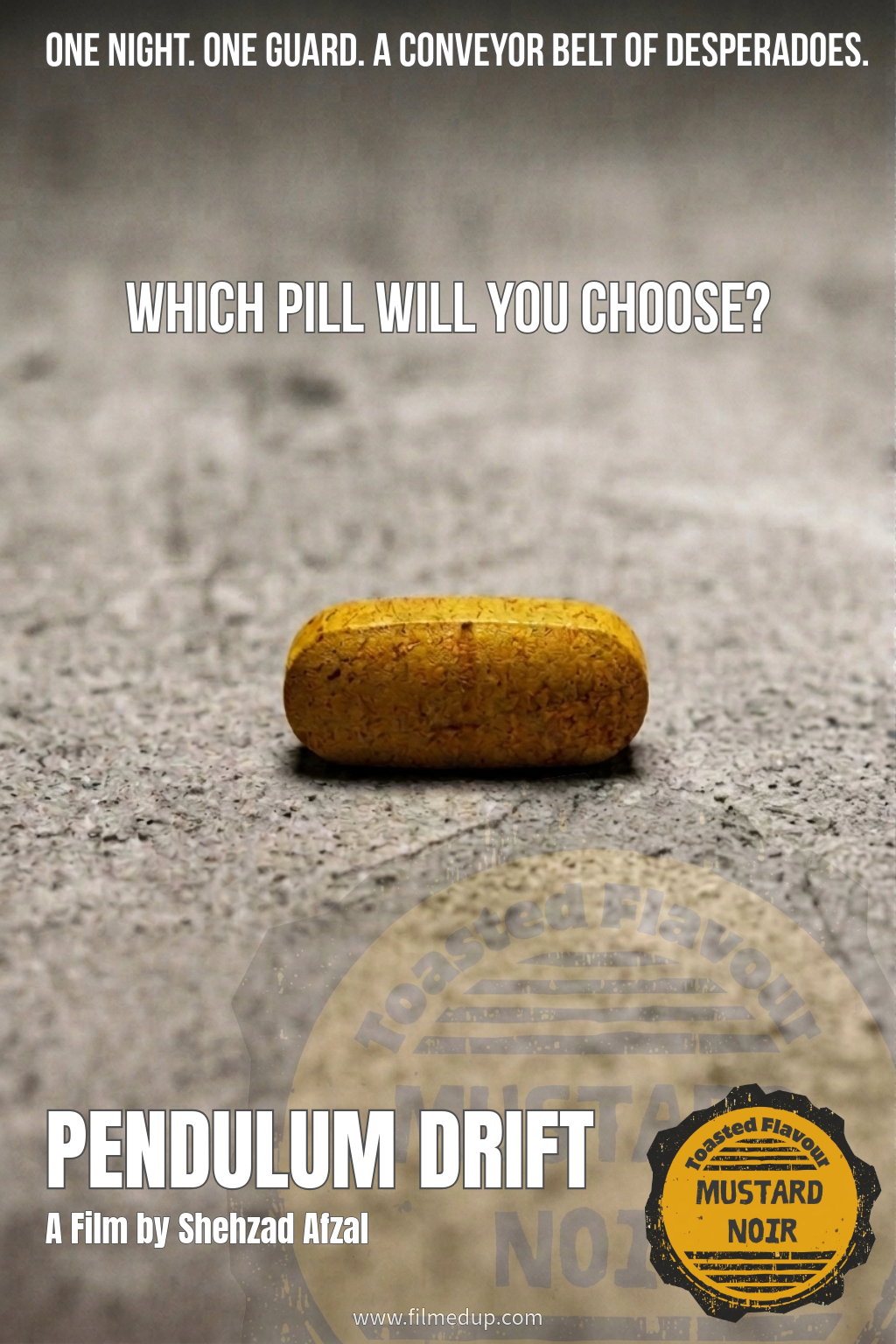
Although the intended collaboration did not materialise, the intent of making a feature film quickly was born true in April 2010, when Pendulum Drift was shot in 5 continous nights coinciding with the Icelandic Volcano eruption, proving that even under extreme stress, a feature film could be shot on a micro budget, and utilised the 7-Stage Adaptive Method researched on the award winning Master's Practice-led Disseratation in 2009 (which ultimately became part of the AFPP/DCOS framework).
Having always strived to work creatively within constraints, 'Pendulum Drift' takes this to the next level. The production was not only efficient but green, using sustainable principles to reduce waste, time, and resource consumption while maintaining the high standards I set for myself as a filmmaker. It’s a project that reflects my belief that art and sustainability can coexist.
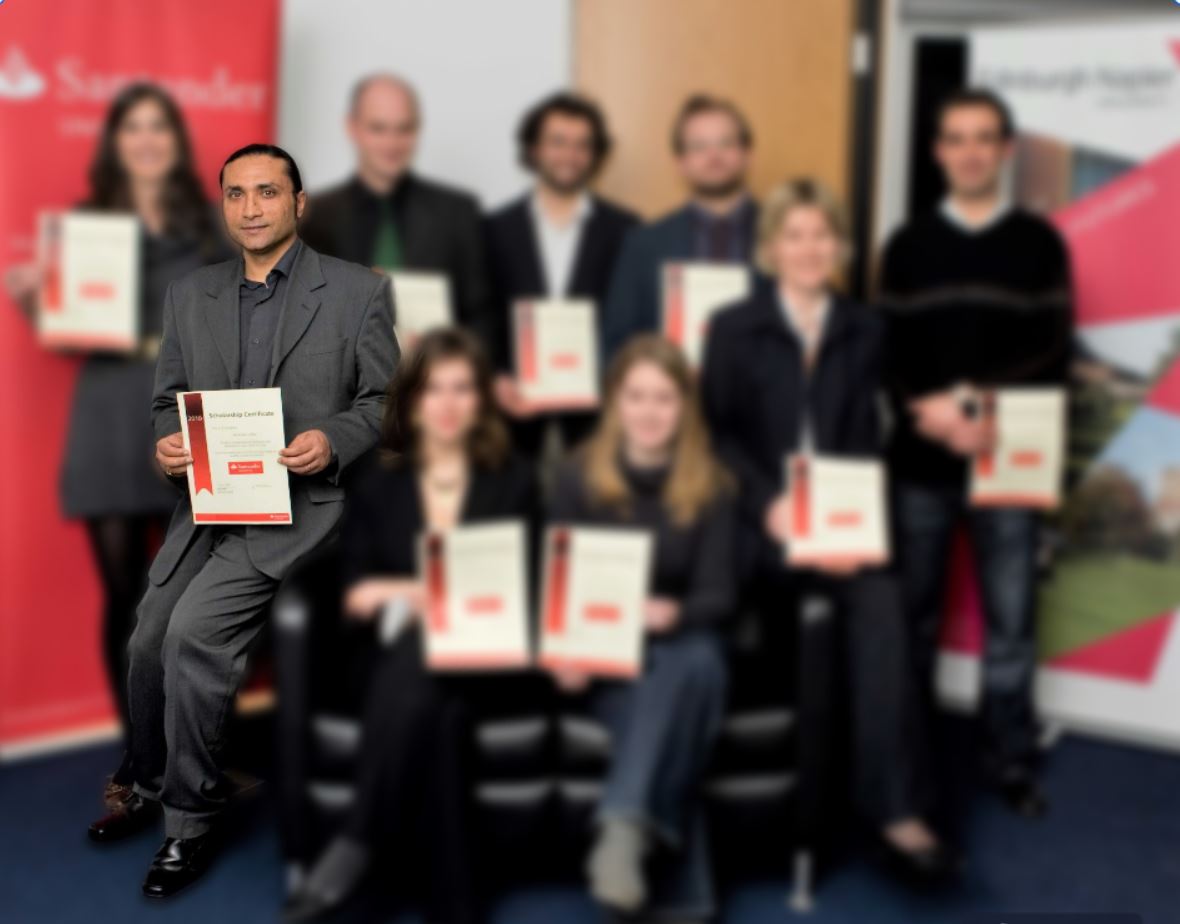
In 2010 he was awarded the Abbey Santander Scholarship Award for Outstanding Achievement in Film and Creative Media at a special event held at Edinburgh Napier University.
Shehzad's main focus is on actor performance and realisation within a neo-noir/social realist/expressionist dimension. Some of the influences include maverick filmmakers such as John Cassavetes, George Lucas, Sidney Lumet, Mike Leigh, Joseph Losey and Sidney J. Furie.
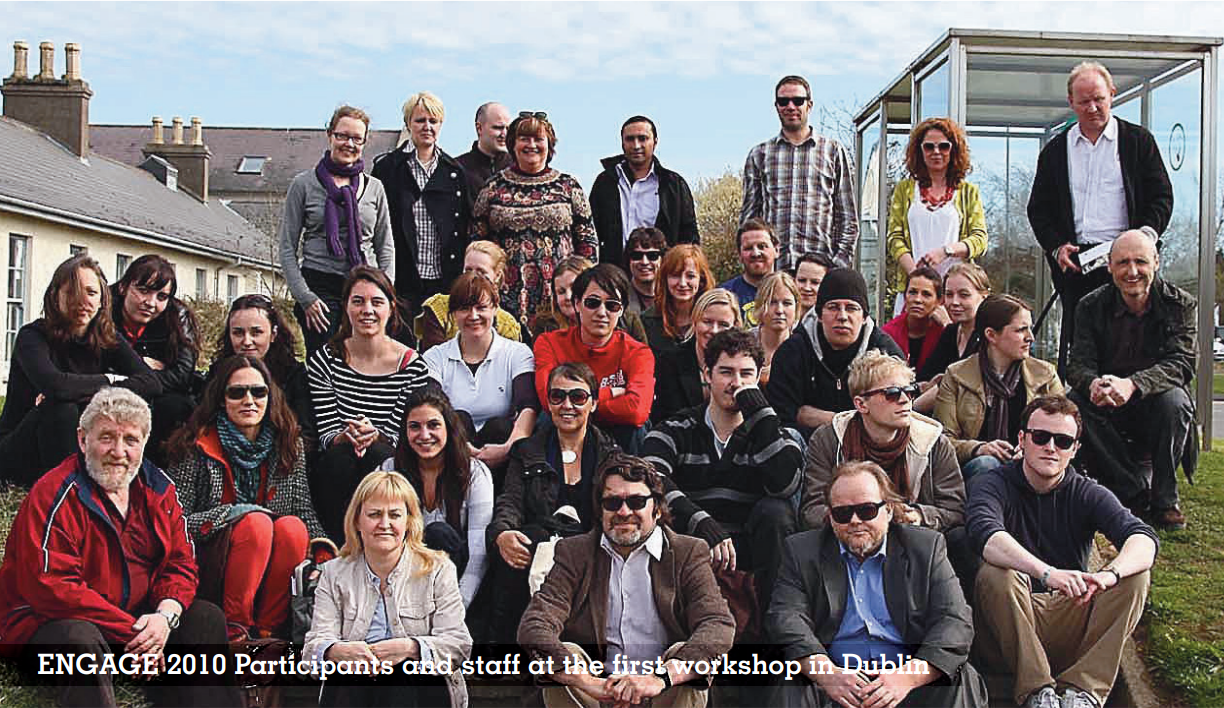
In 2010, Shehzad was selected for a european wide talent development initiative for emerging film talent in Europe, called ENGAGE. The initiative presented masterclasses, seminars, and film project development sessions which took place in Finland, Ireland, Estonia and Scotland, from leading international filmmakers.
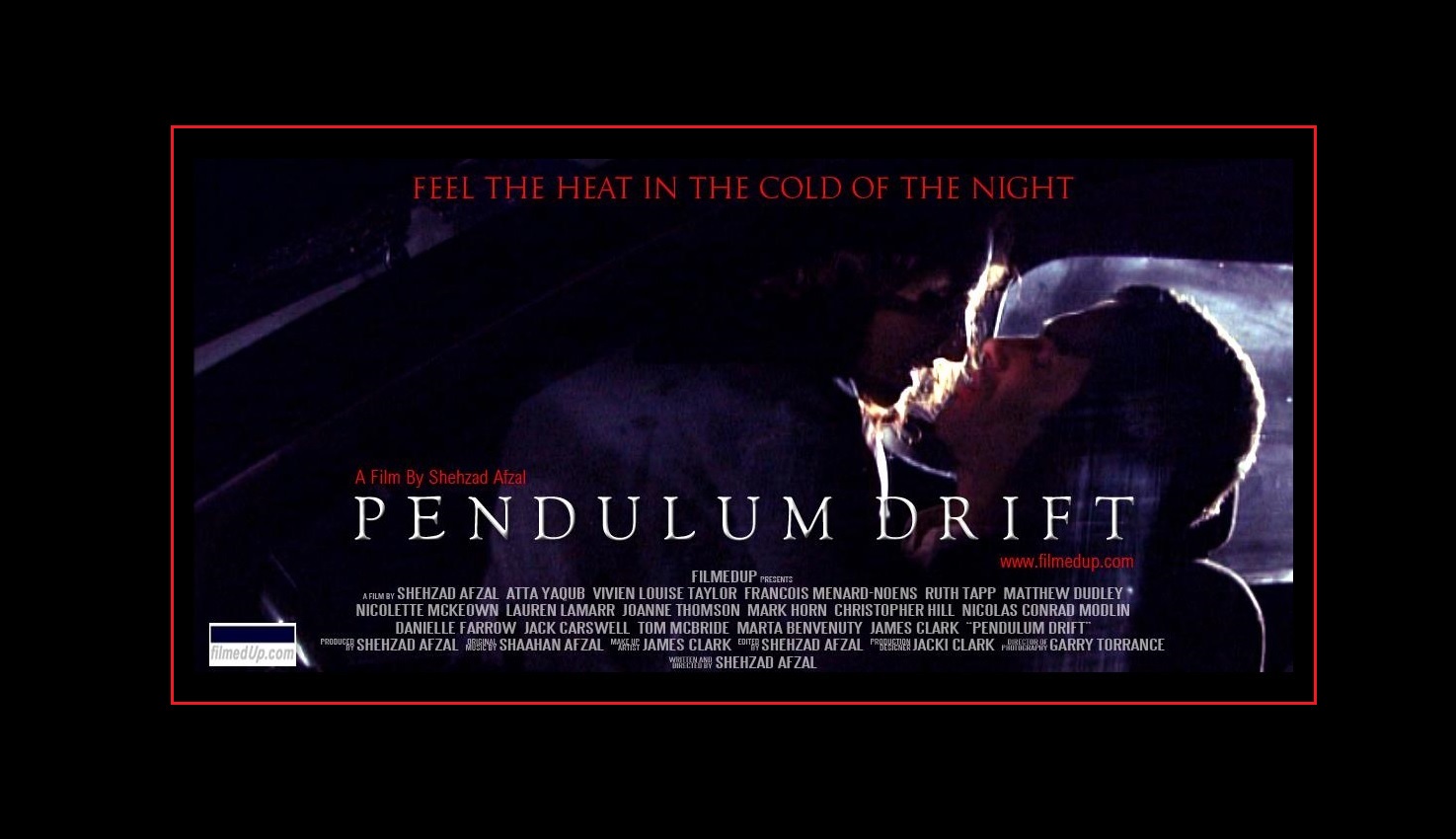
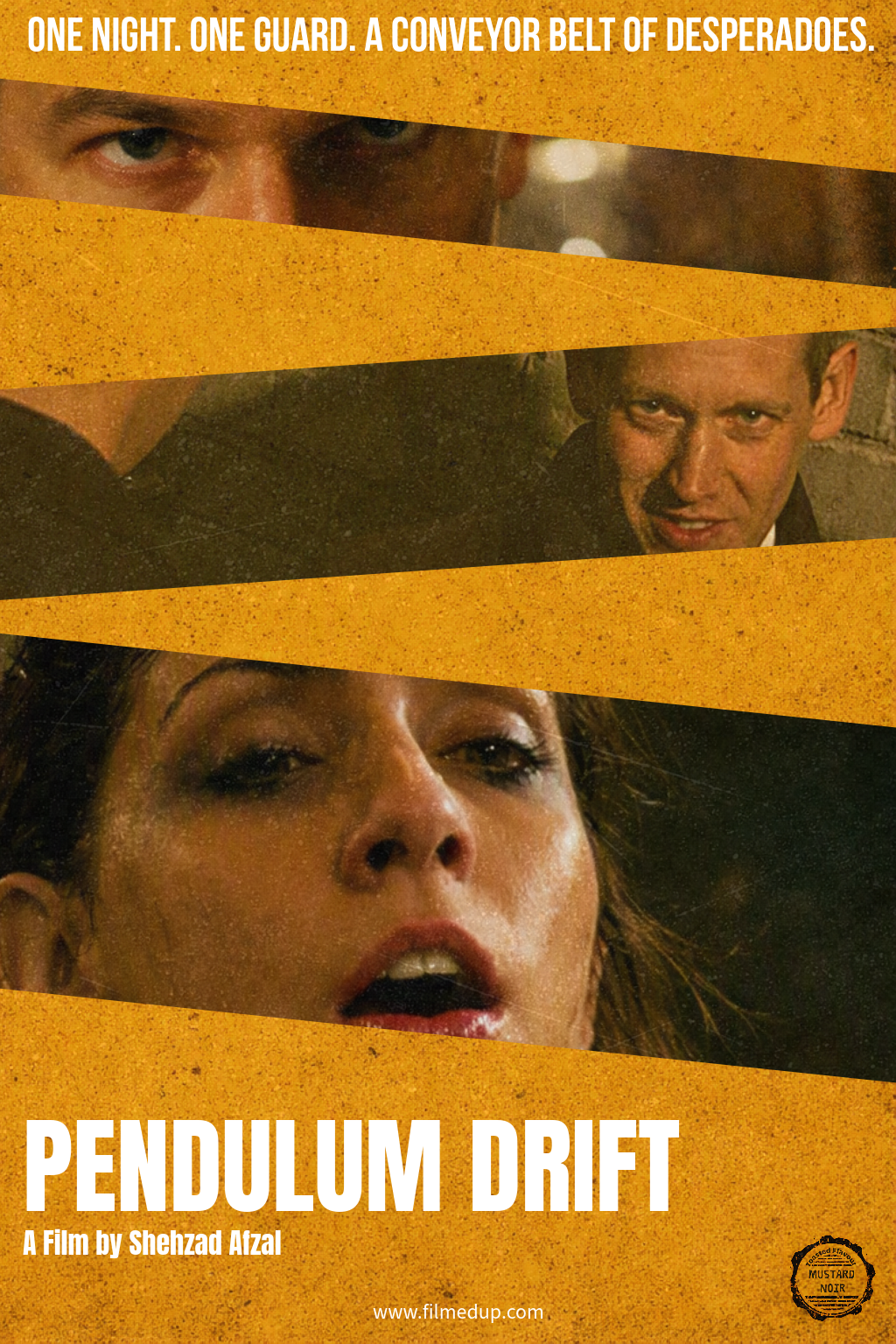
A firm advocate of sustainable film production, Shehzad Afzal crafts neo-noir suspense echoing Cassavetes grit. Pendulum Drift (91min) — his debut feature — earned Portugal Indie Film Fest Best Original Score 2026 for son Shaahan's haunting requiem piano., a self-funded feature length film which would be used to innovate and develop new techniques and processes, leading to eco-friendly film production, and in turn inform the film industry.
During 2019, Shehzad developed an Android Application called Bo Kata Digital, which took his documentary film, Bo Kata, and made it available as a downloadable app, which included the film and some extras such as film notes. Available to download from both Amazon App Store and Google Play Store.
Shehzad further extended his learning and focus on sound design, completing a course in Sound Design for Music & Games from the Academy of Music and Sound in 2023. This supplemented his skills in music scoring and composition which he applied to the Bo Kata Trailer and social media indents a few years earlier. The skills gained from this course would help him to complete the sound design elements for his debut feature film, Pendulum Drift.
Between 2022 and 2025, Shehzad continued his skills development and learning in technology and innovation processes. He successfully completed BSc and MBA level modules in Cybersecurity and Innovation Management at both Abertay University and Edinburgh Napier University. This also included completion of an IBM Cybersecurity Analyst Certification course which he also successfully completed. These skills would augment his technology and eco-friendly approach to media and filmmaking projects.
I’m always learning, whether it’s through my academic studies or in the field of filmmaking. This pursuit of knowledge has allowed me to approach 'Pendulum Drift' in new and exciting ways, blending traditional cinematic storytelling with cutting-edge techniques in sustainability and technology.
Shehzad attested and became a reservist in the British Army at the age of 47 during 2016, joining the Corps of Royal Engineers. He passed basic training at Army Training Centre Pirbright in February 2017 aged 48. Retiring from the Army in 2022, he was awarded the Queen Elizabeth II Platinum Jubilee Medal for his service.
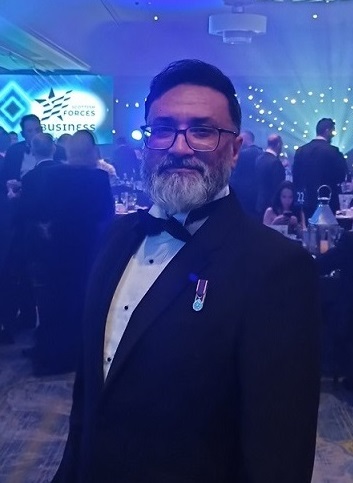
Shehzad's innovative approach to filmmaking has been evident throughout his career. In 2009, he received the Trailblazer Award from Sir Sean Connery in Edinburgh, recognising his emerging talent in British cinema. In 2025, Shehzad was selected as a finalist for the Scottish Ex-Forces in Business Innovator of the Year Award, which celebrated and recognised his achievements in advancing and developing eco-friendly sustainable approaches to film production and creative narratives through innovation.
Shehzad innovated Pendulum Cinema, a novel film language marked by a dramatic oscillation between impressionist subjectivity and expressionist intensity. This was crafted using his new filmmaking framework called Anti-Fragile Production Paradigm, a methodology inspired by Taleb's concepts of antifragility, designed to thrive on volatility and generate new knowledge from constraints.

Shehzad is continuing his education (part-time & evening study) in the fields of innovation and technology where it will allow him to explore and provide new avenues to develop and inform his creative and interactive entertainment career pursuits, in parallel with his full-time 37 years long Information Technology career (Software Engineering, Cybersecurity, Systems Analysis and Design).